High-Power Industrial Electric Tankless Water Heaters Guide
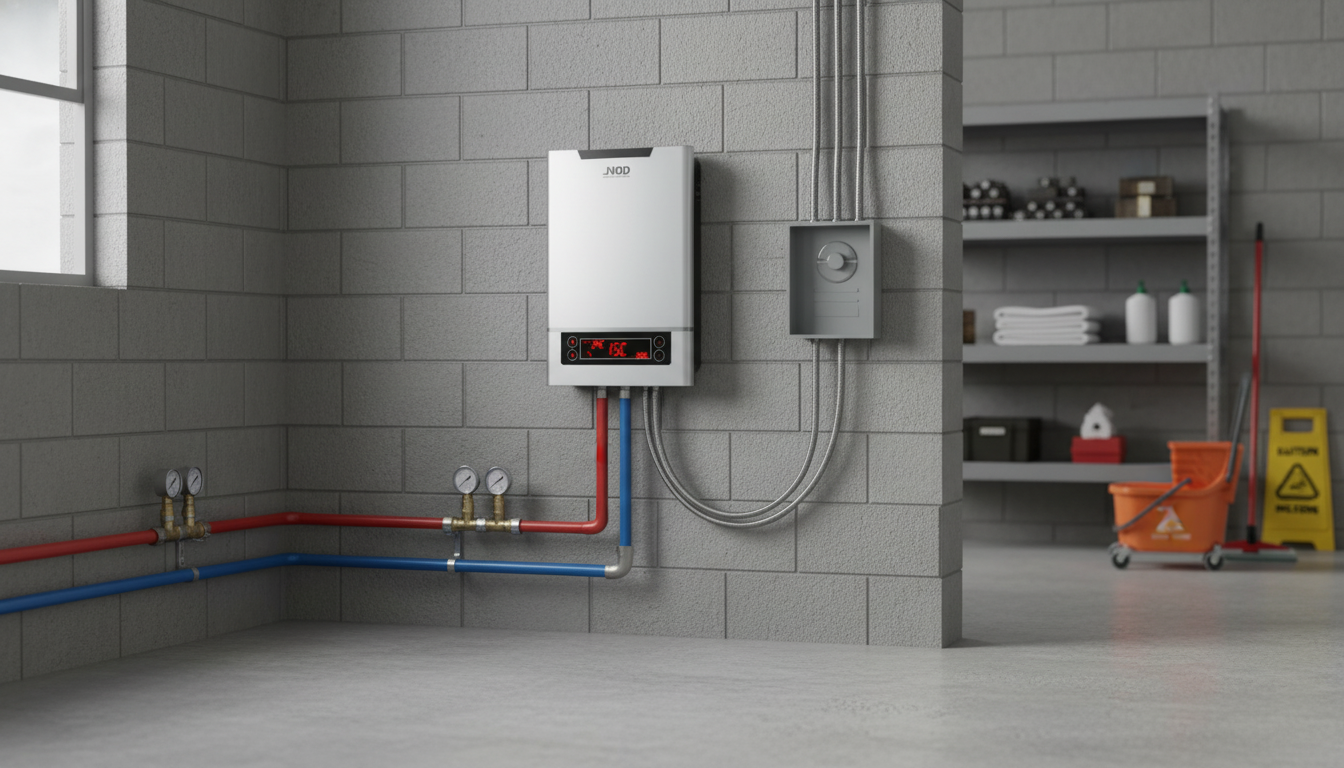
High-power industrial electric tankless water heaters deliver hot water only when a draw is active, which can help demanding facilities reduce standby losses, reclaim floor space, and maintain steadier temperatures for washdown and process support. Because these units can pull substantial electrical power and respond instantly to changing flow, planning the electrical service, plumbing layout, and sizing details up front is the difference between “on-demand” convenience and inconsistent outlet temperatures.
Where High-Power Electric Tankless Systems Fit Best
Industrial-grade, high-power electric tankless heaters are most effective in facilities that need fast response and high-intensity hot water, but not necessarily a continuously large stored volume.
- Process support: washdown stations, parts cleaning, pre-heat loops, and temperature-controlled rinsing where hot water demand is intermittent but intense.
- Facilities operations: locker rooms, breakrooms, and multi-fixture areas where peak demand arrives in bursts (shift changes, cleanup windows, or scheduled sanitation).
- Retrofits and space constraints: replacing bulky storage tanks to free floor area and simplify line rearrangements during expansions or equipment moves.
- Sites prioritizing uptime: avoiding tank corrosion risks and minimizing recovery lag during repeated draw cycles.
For operations that require very large, continuous flows for long periods, a hybrid approach (multiple units or staged heating) can be more resilient than relying on a single heater sized to the absolute maximum case.
How On-Demand Heating Works at Industrial Loads
Tankless systems heat water as it passes through the unit. At industrial loads, small changes in inlet temperature, pressure, or flow can noticeably affect outlet stability—so controls and distribution strategy matter as much as raw kW.
- Flow-activated control: a draw triggers sensors, and the heater ramps power to the elements to hit a target outlet temperature.
- Temperature rise limits: the achievable outlet temperature at a given flow depends on how cold the incoming water is. Colder inlet water reduces the maximum deliverable flow at a fixed setpoint.
- Stable hydraulics help: consistent inlet pressure and flow controls reduce temperature swings when multiple users open/close valves or when process equipment cycles.
- System-level stabilization: many facilities use mixing valves for safe fixture delivery, carefully designed recirculation strategies, or multiple staged heaters (only when permitted by the manufacturer) to smooth performance under variable demand.
For additional background on demand-type water heating and how it differs from storage systems, see the U.S. Department of Energy overview: https://www.energy.gov/energysaver/tankless-or-demand-type-water-heaters.
Sizing and Performance Planning (Flow, Temperature Rise, Duty Cycle)
Correct sizing starts with defining what “enough hot water” means in your building: the temperature required at the point of use, the peak simultaneous flow, and how long those draws last.
Quick sizing checkpoints
| What to confirm | Why it matters | Notes for industrial sites |
|---|---|---|
| Peak simultaneous flow (GPM/LPM) | Determines required heating power at target setpoint | Include washdown hoses and any process draws that can overlap |
| Lowest inlet temperature (seasonal) | Sets the maximum temperature rise needed | Use winter inlet temperature or coldest supply scenario |
| Electrical service capacity | High-power units can require significant amperage | Coordinate with an electrician early; consider load management |
| Water hardness / scaling risk | Scaling reduces heat transfer and can cause failures | Plan filtration/softening and a maintenance schedule |
| Distribution strategy | Impacts wait time and temperature stability | Recirculation and mixing strategies should follow manufacturer guidance |
Electrical and Installation Requirements to Plan Before Ordering
- Voltage, phase, and panel capacity: verify supply voltage and whether single- or three-phase power is available. Many high-power units require dedicated circuits and substantial amperage.
- Code-compliant protection and conductors: coordinate breaker selection, conductor sizing, and disconnect requirements with local code and the equipment documentation.
- Grounding and safe servicing: ensure proper grounding and apply lockout/tagout procedures for installation and maintenance. OSHA’s overview is a useful reference: https://www.osha.gov/lockout-tagout.
- Serviceable plumbing layout: plan isolation valves, unions, and strainers/filters as recommended, with accessible mounting and clearances for maintenance.
- Water quality safeguards: where hardness or sediment is high, add treatment to reduce scale and premature failure.
For facilities aligning water-heating decisions with broader HVAC&R and building standards, ASHRAE’s standards and guidelines library can be a helpful starting point: https://www.ashrae.org/technical-resources/standards-and-guidelines.
Efficiency, Operating Cost, and Load Management
Maintenance and Reliability in Industrial Environments
High-Power Industrial Electric Tankless Water Heater (Product Overview)
Related In-Stock Items
- Vintage Glass Pendant Light with LED Compatibility for Indoor and Outdoor Spaces
- Simple Daily Rituals to Soothe Your Mind – Digital Guide for Simple Rituals to Calm My Mind Daily, Stress Relief, Mindfulness Routine & Mental Clarity
- Solo Traveler’s Guide to Staying Safe | Guide | Digital Download PDF eBook | Solo Travel Safety Tips & Checklist | Travel Security Planning
FAQ
Can an electric tankless heater support multiple industrial washdown hoses at once?
It depends on the combined peak flow rate and the required temperature rise at the coldest inlet water condition. If simultaneous hoses exceed the heater’s capacity, consider multiple units in parallel or a staged approach to maintain temperature.
What electrical service is typically needed for a high-power industrial electric tankless heater?
High-power units often require large amperage, dedicated circuits, and the correct voltage and phase (single- or three-phase) for the model. Verify panel capacity, breaker and wire sizing per local code and manufacturer documentation, and involve a licensed electrician early.
How can scale buildup be prevented in an industrial tankless water heater?
Use water treatment matched to measured hardness (such as filtration and softening where appropriate) and follow a routine descaling/flush schedule based on runtime. If temperature stability worsens or pressure drop increases, treat it as an early warning sign of scaling or flow restriction.












Leave a comment