Smart Air Purifier for 3576 sq ft Rooms: Setup Guide
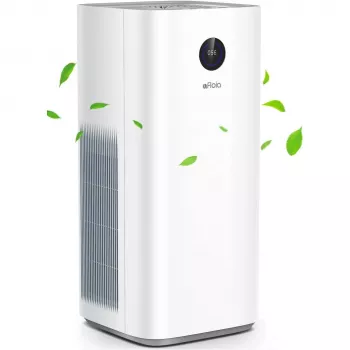
Smart Air Purifier for Large Rooms up to 3576 sq. ft: What to Look For and How to Set It Up
A large-space air purifier needs more than a big fan. For open-concept living areas, finished basements, gyms, studios, or multi-room zones, the right unit balances coverage, filtration performance, automation, and manageable upkeep. This guide breaks down the key features to prioritize and how to dial in placement and settings for consistent, whole-room results.
Who a large-room smart purifier is built for
- Open layouts where air mixes across connected rooms (living room + kitchen + hallway).
- Homes with pets, frequent cooking, or seasonal pollen that can linger in large volumes of air.
- Workspaces and studios where steady airflow and scheduling matter more than “boost mode.”
- Anyone who wants hands-off control via sensors, app automations, or voice assistants (where supported).
Coverage and airflow: sizing for up to 3576 sq. ft
“Up to 3576 sq. ft” can be a helpful starting point, but it’s not the whole story. Maximum coverage is typically measured under ideal conditions—think standard ceilings, minimal obstructions, and good air mixing. Real homes include doorways, furniture, and dead zones that slow circulation.
For consistently cleaner air, aim for stronger air exchange where people actually spend time (the seating zone, a home office corner, or a workout area) rather than chasing one “whole home” number. And if your space is broken into separate rooms with closed doors, a single large purifier may not replace the need for filtration in each room.
| Room layout | What to prioritize | Practical tip |
|---|---|---|
| Single large open area | High airflow with stable auto mode | Place near the center path of airflow, not in a corner |
| Open area with cooking zone | Strong particle + odor reduction | Run a higher setting during and 30–60 minutes after cooking |
| Mostly separate rooms | Air circulation per room | Keep doors open or consider multiple units for closed rooms |
| High ceilings / loft | More circulation to mix air | Use a medium-high baseline to avoid “clean at floor, stale at ceiling” |
Filtration essentials: particles, smoke, and odors
Start by separating two jobs: removing particles (dust, pollen, dander, smoke particles) and reducing odors/gases (cooking smells, pet odor, some VOCs). For particles, look for a true high-efficiency filter design (often HEPA-class) with clear specs rather than vague “99%” statements without particle size context.
If odor control matters—especially with cooking or wildfire smoke—activated carbon (or similar sorbent media) becomes the difference-maker. Carbon performance is strongly tied to how much media is used and whether the unit has a sealed airflow path that forces air through the carbon instead of around it. Even excellent filter media can underperform if the filter fit is loose and allows bypass.
Finally, don’t overlook a pre-filter. In pet homes, a pre-filter that catches hair and larger debris can noticeably extend the life of the main filter and keep airflow from dropping too quickly.
Smart features that actually improve day-to-day use
Noise, power use, and comfort in big rooms
Placement: where a large purifier works best
- Give it space: Leave breathing room around the intake and exhaust; avoid pressing it tight against walls, couches, or curtains.
- Intercept real airflow paths: In open-concept areas, place it where air naturally travels—between the seating zone and kitchen, or near a hallway transition that feeds multiple zones.
- Avoid “sensor traps”: Don’t put it right beside a stove, humidifier output, or incense/candle area. Sensors can read a concentrated plume and ramp unnecessarily.
- During smoke events: Pair purifier use with tighter envelope habits—keep windows closed and use controlled ventilation when conditions improve. The U.S. EPA’s overview of home air cleaners is a helpful baseline reference: https://www.epa.gov/indoor-air-quality-iaq/air-cleaners-and-air-filters-home.
For additional context on ventilation (which complements filtration), the CDC’s guidance can help you balance fresh air with comfort during different seasons: https://www.cdc.gov/respiratory-viruses/prevention/ventilation.html. If you’re comparing models, CADR explains how airflow and filtration combine into clean-air delivery: https://www.aham.org/AHAM/Programs/CADR.
Maintenance and ongoing costs to plan for
A practical setup routine for the first week
Smart Air Purifier for Large Rooms up to 3576 sq. ft: product snapshot
| If the priority is… | Look for… | Why it matters |
|---|---|---|
| Allergy seasons | Strong particle filtration + stable auto mode | Helps keep airborne pollen and dust down with minimal babysitting |
| Cooking odors / smoke | Robust odor media + higher airflow | Reduces lingering smells faster in large shared spaces |
| Quiet evenings | Comfortable mid-speed sound profile + night mode | More likely to run consistently (and consistency is key) |
Helpful add-ons for a calmer, more comfortable home
- Simple Daily Rituals to Soothe Your Mind – Digital Guide for Simple Rituals to Calm My Mind Daily, Stress Relief, Mindfulness Routine & Mental Clarity
- Solo Traveler’s Guide to Staying Safe | Guide | Digital Download PDF eBook | Solo Travel Safety Tips & Checklist | Travel Security Planning
- Vintage Glass Pendant Light with LED Compatibility for Indoor and Outdoor Spaces
FAQ
Can one air purifier handle multiple rooms?
It can help in open layouts where air mixes freely, but closed doors limit circulation. Place it near shared airflow paths (like a hallway transition), and consider multiple units for rooms that stay shut most of the day.
How long should a large-room purifier run each day?
For steady results, it typically runs continuously on auto mode or a quiet baseline speed. Use higher speeds during events like cooking, cleaning, or smoke exposure, then return to a comfortable baseline.
Do air purifiers remove odors and VOCs?
Particle filters target dust and smoke particles, but odors and many gases require activated carbon or other sorbent media. Odor reduction varies widely based on carbon amount, airflow design, and how strong the source is.









Leave a comment